Beyond Horizon | HIKE Capital 2025 Annual Investor Meeting: AI, Globalization and Champion Resilience
HIKE Capital’s 2025 US Fund Annual Investor Meeting was successfully held in Beijing on Nov. 26, 2025.
The end of 2025 coincides with the 10th Anniversary of HIKE Capital. As a founders fund rooted in China yet possessing a global perspective, we have chosen “Beyond Horizons” as the theme for our AGM.
This annual conference serves not only as a review of the past decade, but also as a rally call for dialogues with investors, entrepreneurs, and industry partners to explore crucial growth drivers in the new cycle. Topics include breakthroughs in AI technology implementation across industries, pathways to building globalized and systematic capabilities, and industrial upgrades driven by quality productivity forces.
HIKE Capital also specially invited legendary champion coach Jenny Lang Ping, who recently received the International Olympic Committee’s Lifetime Achievement Award for Coaches, to discuss the “champion resilience” required to navigate through cycles.
01 Anna XU: Anchored on “The Few Driving Paradigm Shifts”
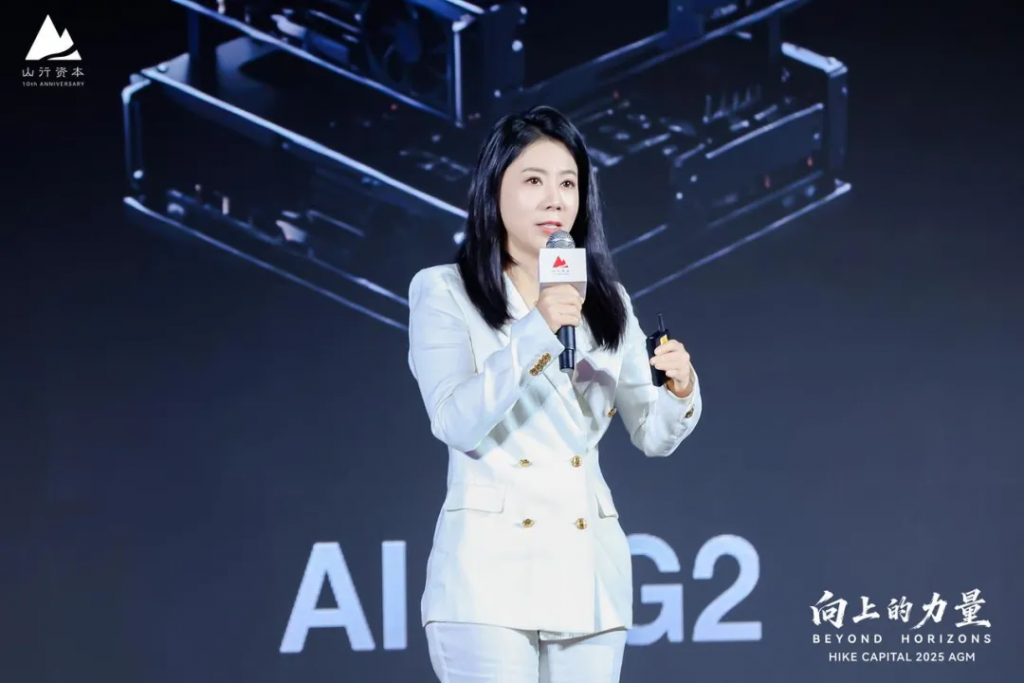
Anna XU, Founding Partner, HIKE Capital
Standing at the new starting point of a decade, Anna XU, Founding Partner of HIKE Capital, returns to the original aspiration of entrepreneurship: “From 2016 to 2025, human history has witnessed its most intensive period of technological transformation. HIKE has always stood at the forefront of trends, with one core pursuit — to identify and empower the exceptional few who are driving paradigm shifts.”
From its inception, HIKE positioned itself as a Founders Fund. Building upon the partners’ over 20 years of industrial experience, the team delves into the industrial front lines with an almost extreme pragmatic spirit. Its differentiated advantage lies in the details: to deeply research a certain D2C sector, the team visited over a hundred smart manufacturing factories; to verify the service efficiency of overseas and domestic platform companies, the team consistently conducted extensive user interviews and on-the-ground order tracking; HIKE also leverages its capability in managing hundreds of millions in traffic and global advertising placements to help portfolio companies achieve precise AI advertising implementation and business growth.
In each fund, the GPs commit 10%-20% of the capital, highly aligning interests with investors. During industry downturns, the principle is to “cherish resources and be responsible for every decision and every act of trust.” In difficult times, the focus is on supporting and accompanying portfolio companies through challenges.
After a decade of iteration, HIKE’s investment methodology has evolved from the 1.0 era of early-stage sector coverage, upgraded to the 2.0 era focusing on core early and growth-stage sectors, and is now entering the 3.0 era, marked by a series of figures: 6 portfolio IPOs to date, with an additional five expected in the next 1-2 years; 30% of our portfolio companies have grown into unicorns, achieving over 10x investment returns. This also stems from HIKE’s ability to identify “Super Founders” — HIKE was among the earliest investors in companies like Yuanbao Group, Halara, and Megatronix Technology. Regarding “Super Timing,” HIKE has its own independent decision-making framework and investment criteria. It co-led the investment in Li Auto during the low point of the EV sector in 2017 and led the investment in RELX during a phase of non-consensus. HIKE has consistently made multiple rounds of follow-on investments in these high-growth companies, accompanying founders with concrete actions.
Discussing current core sectors, Anna Xu anaylyzed that opportunities in the new cycle are concentrated around two main themes: “Scalable AI Applications” and “Global Expansion.”
“The steam engine liberated muscle power, electricity liberated production, the internet connected information, and AI is the first to liberate ‘thinking’ itself.”
Anna shared a set of key observational data: In early 2024, the average daily inference token volume for Chinese large language models was only 100 billion; by September 2025, it had skyrocketed to 30 trillion — a 300-fold increase in two years. The cost per million tokens dropped from $60 in 2023 to just a few cents domestically today. “When the cost approaches zero and user penetration exceeds 20%, the window for scalable AI applications has fully opened.” With Chinese entrepreneurs leading in open-source capabilities, and continuous improvements in performance, cost, and user behavior penetration, HIKE made the judgement that the window for the explosive scaling of inference applications is now open and has actively invested in several companies.
Regarding globalization, HIKE’s understanding of going global is not merely “product export” but “the global export of Chinese capabilities.” Anna proposed two clear “Global Growth Formulas” to identify the core competitiveness of Chinese enterprises:

“China possesses globally leading supply chains — new energy vehicles account for 70% of the global share, and Chinese brands hold 3 of the top 5 spots in the global mobile phone market. On the demand side, it has evolved from OEM imitation to digital insight and cultural IP export. On the channel side, it has cross-platform global reach capability.”
“Over the next 20 years, China will undoubtedly continue to produce world-class entrepreneurs. What HIKE looks for are those who can transform policy uncertainties into controllable variables and translate technology into practical applications — this is not simple business cooperation but a way to participate in the innovation of commercial civilization.”
02 Panel Debates: “AI Innovation” and Practical Wisdom in the New Cycle
The AGM roundtables did not prepare “standard answers.” Instead, they invited frontline AI practitioners to discuss “pitfalls in AI implementation” and “difficulties in globalization.” These genuine concerns are precisely the most valuable innovation samples for the new cycle.
Panel Discussion 1: Enterprise Innovation in the GenAI Era
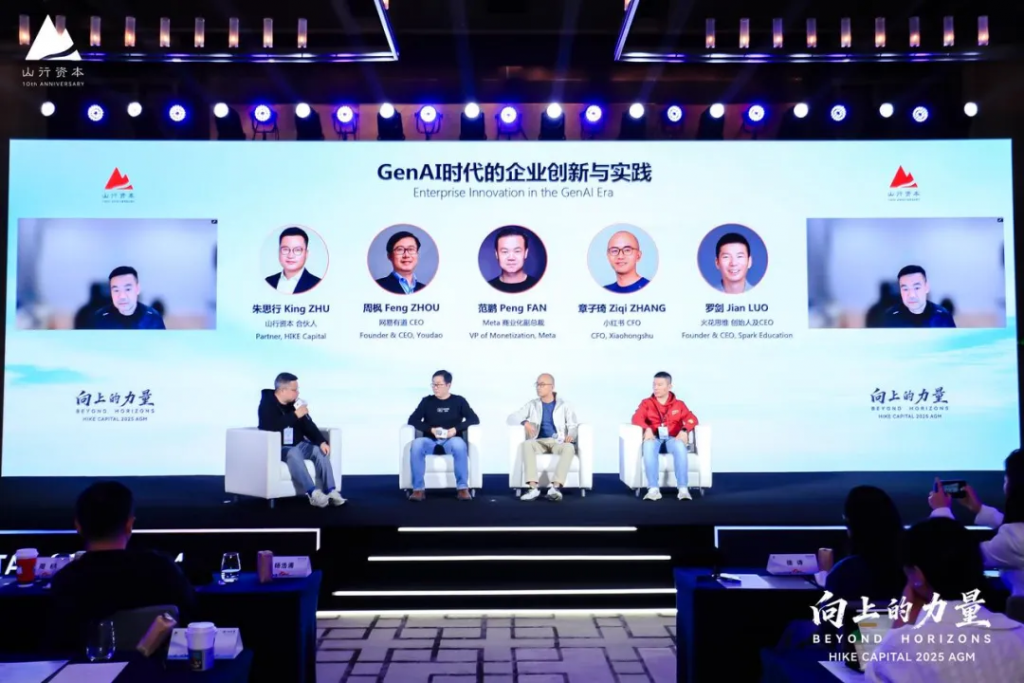
In the panel of “Enterprise Innovation in the GenAI Era”, insights from Peng FAN, VP of Monetization at Meta, Feng ZHOU, Founder & CEO of Youdao, Ziqi ZHANG , CFO of Xiaohongshu, and Jian LUO, Founder & CEO of Spark Education, focused on “the actual value boundaries of AI.”
Peng FAN mentioned Meta’s practice: After reconstructing the ad system with large models, ROI increased by 15%, but “with 50% of code AI-generated, maintenance time actually increased.” Instead, the real value lies in non-engineering areas like content moderation and meeting minutes.
Feng ZHOU pointed out the “cognitive gap” in AI education: “AI being able to solve problems doesn’t mean it can teach — ChatGPT directly outputting answers is not the best choice for children with weaker independent learning abilities.” Youdao is honing “guided teaching” capabilities to transform AI from a “problem-solving tool” to a “learning partner.”
Ziqi ZHANG focused on AI’s potential “backlash” against content platforms: “The core is to use AI to optimize the community, not replace real human interaction.” Xiaohongshu increased its machine-review rate from 95% to 99% but is still exploring the integration of “search” and “Q&A” experiences to avoid losing authentic social attributes.
Jian LUO stated: After the “double reduction” policy, Spark used AIGC to transform its original art team. “Those who participated in the technological interation stayed; those who resisted were eliminated.” However, AI is always positioned as a “teaching assistant,” unable to replace the “human touch” in early childhood education.
Panel Discussion 2: New Quality Productivity Driving Chinese Companies’ Global Expansion
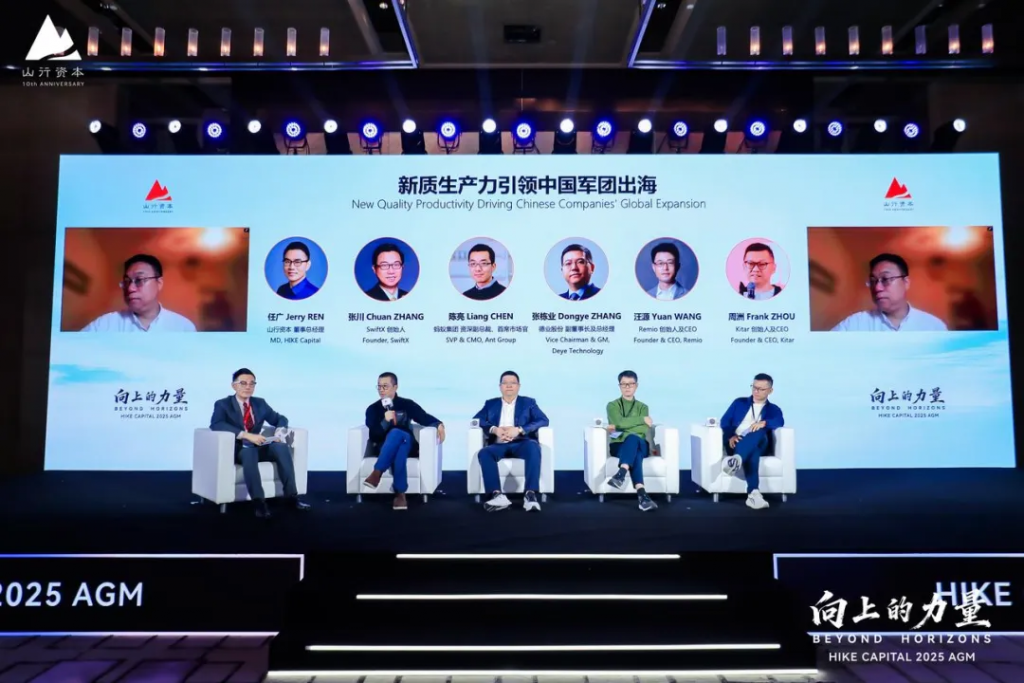
The “New Quality Productivity Driving Chinese Companies’ Global Expansion” Panel focused on “the logic of adaptation for globalization.” Sharing from guests including Chuan ZHANG, Founder of SwiftX, Liang CHEN, SVP & CMO of Ant Group, Dongye ZHANG, Vice Chairman & GM of Deye Technology, Yuan WANG, Founder & CEO of Remio, and Zhou ZHOU, Founder & CEO of Kitar, shattered the illusion of “model replication.”
Liang CHEN shared Ant Group’s “dual-track globalization logic”: Early-stage investments in Southeast Asian payment companies used local brands and local CEO structures, without taking over on shares. Now, its 2B business focuses on globalization from the outset, “following demand, not exporting models.”
Dongye ZHANG told the story of a traditional manufacturer’s transformation: Deye Technology moved from home appliances to new energy, primarily targeting off-grid markets in Asia, Africa, and Latin America. “With daily power outages of 10 hours in Ukraine, our energy storage products are like ‘giant power banks.’ Using a home appliance mindset to create 2C products, our cost-effectiveness is about 30% higher than European companies.”
Yuan WANG added from an office AI perspective: “Globalizing companies often encounter the problem of ‘document fragmentation’.” Remio’s solution is to let AI autonomously link offline materials and cloud documents from global teams.
Zhou ZHOU seized the “time-machine opportunity” in Southeast Asia’s second-hand market: “Similar to Zhongguancun 20 years ago, with opaque information and difficulty in authentication,” the team replicated the “Xianyu + Aihuishou” model, achieving 60% monthly growth. “However, the execution capability of the localized team is more critical than the model itself.”
Panel Discussion 3: How AI is Reshaping the Logic of Smart Terminal Industries
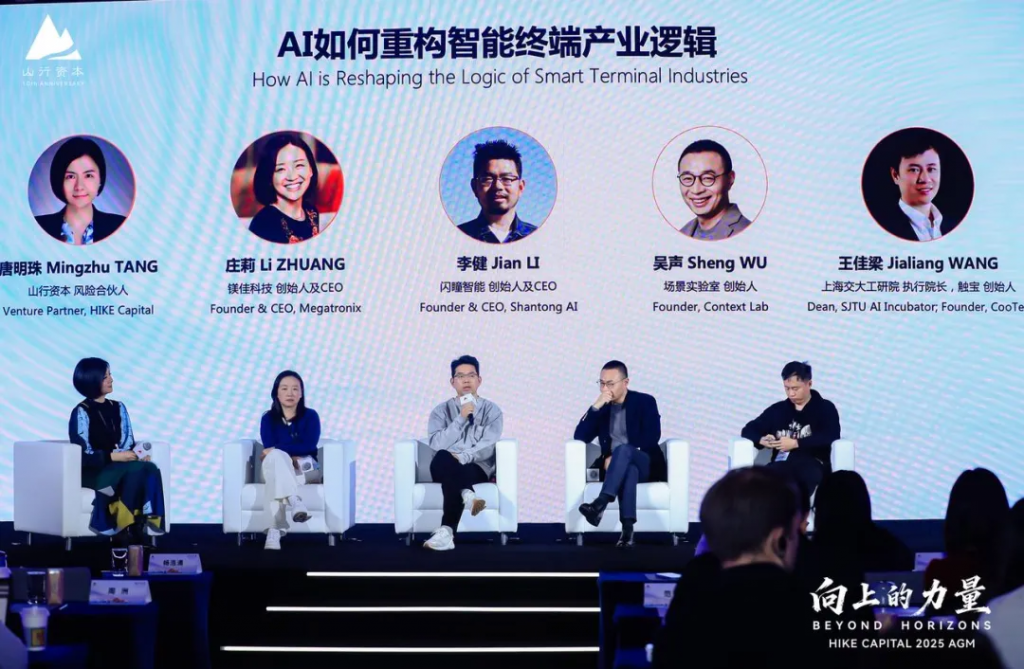
Smart terminals represent a traditional strength of China’s industrial sector and one of the supply chains undergoing the most intense AI-driven reshaping.
Li ZHUANG, Founder & CEO of Megatronix, Jian LI, Founder & CEO of Shantong AI, Sheng WU, Founder of Context Lab, and Jialiang WANG, Dean of SJTU AI Incubator and Founder of CooTek, focused on “how AI is rewriting terminal logic.”
Li ZHUANG, heavily involved in automotive intelligence, pointed directly to industry pain points: “Automotive intelligence is not about stacking hardware; it’s about software-defined experience.” By optimizing software, mid-to-low-end Qualcomm chips can deliver high-end intelligent driving performance. When data limit for autonomous driving slowed down development, the team used simulators + AIGC to generate corner cases, enabling“data accumulation efficiency increased 10x, costs reduced 50%.”
Jian LI focused on AI photography, starting from user pain points: “A girl wants ‘golden, shiny hair,’ but her boyfriend’s photo turns out dark — what AI needs to do is ‘achieve what is imagined’.” Shantong AI aimed to make AI understand “aesthetic emotion,” making it no longer difficult to automatically take beautiful photos.
Sheng WU proposed “terminal as scenario flow” from a trend perspective: “In the past, terminals handled single-point tasks; now AI turns them into ecosystems. China’s terminal advantage has already shifted from manufacturing to scenario implementation capability.” Simultaneously, in the AI era, the scarcest resource is not problem-solving ability, but the ability to ask questions.
Jialiang WANG focused on the innovation threshold: “Claude code enables non-technical beginners to code a Feishu bot in 2 hours — this is a paradigm shift.” He believed AI’s greatest value for terminals was “lowering the cost of niche innovation.”
03 Breaking Through with Practical Action: The New Quality Productivity Practices of Portfolio Companies
Two founder sharing sessions at the AGM featured two exemplary founders from HIKE’s portfolio: Joyce ZHANG, Founder & CEO of Halara, and Ying LI, Co-founder & COO of Yuanbao. Both discussed HIKE’s deep involvement in companies’ early stages during seed rounds.

Joyce ZHANG, Founder & CEO of Halara
Their stories validate HIKE’s investment philosophy: not investing in “hot sectors,” but only in “people who can solve real problems” — those who understand technology yet grasp industries; who innovate yet master execution. Only “deep integration of technology and industry” can drive paradigm shifts in industries.
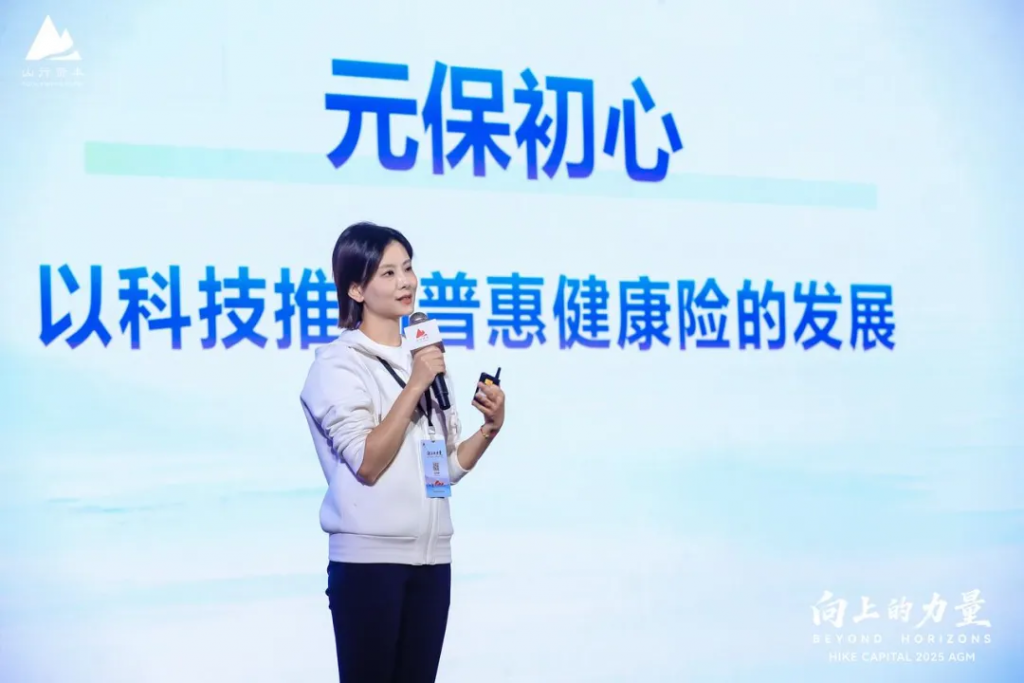
Ying LI, Co-Founder & CEO, Yuanbao
In the field of inclusive insurance, Yuanbao tackles the industry pain points of “difficulty in building trust and reaching users,” as commercial health insurance needs to fill a 700 billion RMB gap.
Yuanbao’s solution transforms “cold insurance” into “warm protection” through AI:
- Intelligent customer service can recognize dialects and accurately respond to specialized terms like “imported chemotherapy drugs.”
- Intelligent claims processing can automatically link all user policies, while multimodal technology can sort disorganized documents, compressing claims processing time from days to hours.
- For easily confused products like “Zhongxiangbao” and “Zhongminbao,” Yuanbao’s vertical model can precisely output deductibles and payout ratios.
“Let technology illuminate the faintest glimmers, let protection reach the farthest corners,” said LI Ying.
04 Championship Dialogue: Understanding the “Champion’s Heart” from Jenny Lang Ping
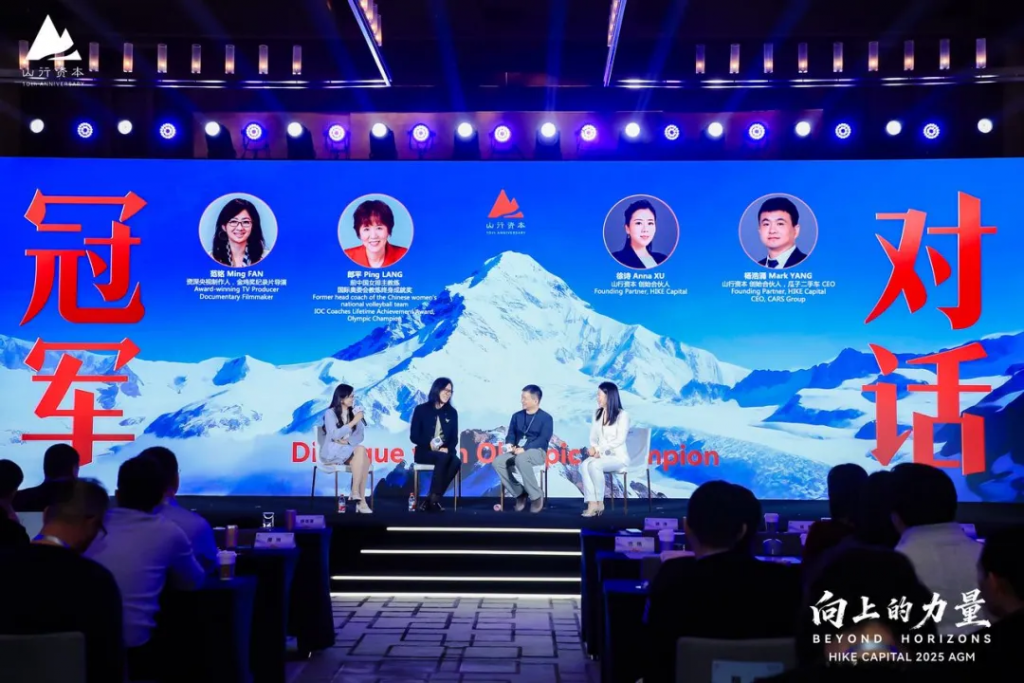
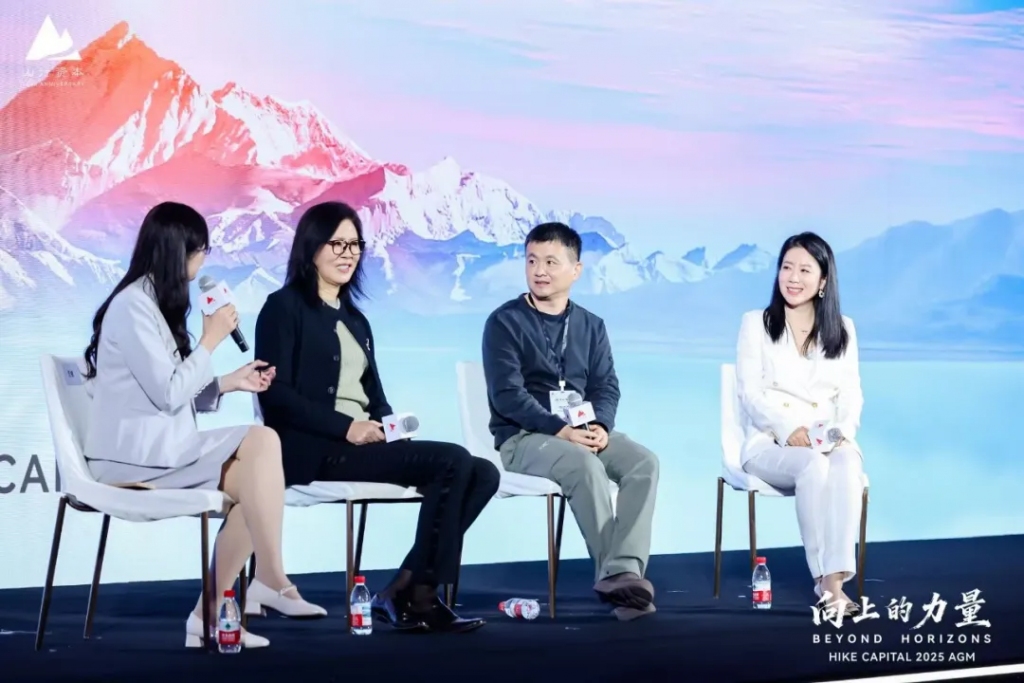
On its tenth anniversary, HIKE also invited Jenny Lang Ping, former head coach of the Chinese Women’s Volleyball Team and recipient of the International Olympic Committee’s Lifetime Achievement Award for Coaches, to engage in a special dialogue on the theme of “Champion’s Heart” with HIKE Founding Partners Anna XU and Mark YANG. Hosted by Ming FAN, former senior producer at CCTV and Golden Rooster Award-winning documentary director, the conversation featured a dynamic exchange on the spirit of champions, extracting the “champion logic” for entrepreneurship and investment from the cross-disciplinary perspectives of Coach Lang and the two founders.
Coach Lang said that in volleyball, there are only wins or losses, no draws, but the key to victory lies not solely in talent, but in “scientific training, systematic support, and putting enough pressure during daily practice.”
After losing the finals to the USA at the 2014 World Championships, Coach Lang immediately analyzed the reasons for the loss with the Chinese team, clearly stating the goal: “We weren’t strong enough; this championship didn’t belong to us — but if we train hard enough for a few years, we can definitely defeat them.”
To hone technical precision and prevent players from being conservative at crucial moments, the team established an ironclad rule for serving drills: each player must deliver 10 consecutive good serves to end practice. One single mistake means one extra serve. Everyone must pass, and the entire team cheers on those doing extra drills.
“Nothing to Lose — every day of training is a gain. Even an off day adds to your experience.”
Quickly responding to emergencies to overcome adversity—When coaching Team USA, a key player abruptly withdrew from the squad days before a major tournament due to “personal reasons.” Coach Lang quickly recalled veteran players to fill the gap. Learning from experience—From then on, she ensured two backup players for every position. Though it meant more preparation for the coaching staff, it prevented the team from panicking.
Mark YANG, founding partner of HIKE, discussed the common ground between entrepreneurship and investment: “Winning battles is the best way to build culture—when the team sees that our product outperforms competitors and our service exceeds expectations, it’s more effective than any slogan.”
In Anna XU’s view: “As a leader, you must possess decisiveness, empathy, and tenacity. Back when we built the NetEase News app, the team developed in isolation in a residential building in Wudaokou, climbing twelve flights of stairs daily. A group of twenty-somethings doggedly pursued innovation, growing from zero to hundreds of millions of users—all fueled by the belief that ‘even with just rice and rifles, we can achieve great things.’”
The common ground between sports and business is that there are no shortcuts or lucky breaks. You need a “champion’s heart”—not just to “win once,” but to “win consistently.” This means enduring tough times with resilience, building advantages through daily incremental progress, and navigating cycles with a long-term perspective.
05 A Decade Upward: In the Name of Founders, Embracing the Next Cycle
“Beyond Horizons” embodies the courage of founders breaking through in globalization, the determination of AI to transition from technology to industry implementation, the resilience of champion teams to persevere through adversity, and above all, the original intention of HIKE, as a “Founders Fund,” to accompany change-makers day in and day out for a decade.
Ten years ago, HIKE embarked on its entrepreneurial journey. A decade later, standing at the crossroads of AI and globalization, we remain committed to our mission: “to identify the exceptional few who drive paradigm shifts.”
As Anna Xu said: “VC is a fascinating profession — if we fully anticipated risks, many great adventures would never begin.” HIKE’s “Beyond Horizons” is precisely about honoring and embracing that very spirit of adventure: respecting the laws of cycles, while seizing transformative opportunities.
Over the next decade, AI will continue to reshape industries, globalization will enter a new phase, and new quality productivity will redefine supply. We aspire to walk alongside founders with an entrepreneurial spirit, and to accompany them through cycles with a champion’s resolve.
HIKE’s decade has been one of navigating cycles alongside Chinese founders. Moving forward, we will continue to honor our “founders fund” DNA, supporting those exceptional few who drive paradigm shifts—for upward momentum will always belong to visionaries who dare to dream, dare to fight, and dare to persevere.